PUBLIC PLANT DOSSIER · 4 MINUTE READ
Peace lily
Spathiphyllum species and cultivars
Read the pot before the posture, and the botanical name before the common one.
A peace lily’s familiar droop can tempt an immediate response. Make a pause for the pot: record moisture, drainage and recent care before deciding what the posture means. Flowering, leaf appearance and the state of the mix provide different kinds of information, and none should quietly stand in for the others.
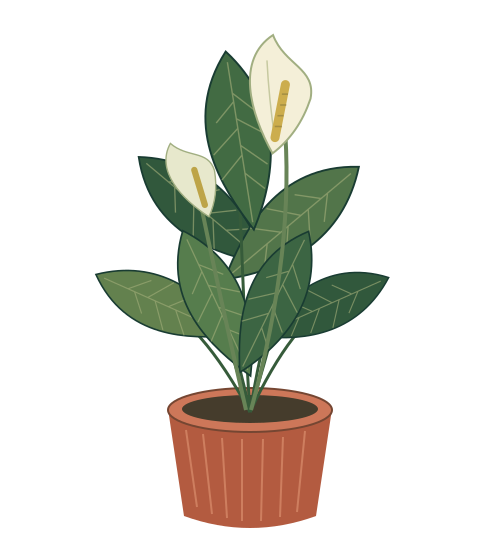
Growth habit
A leafy clump; the showy spathes change as they age.[1]
Light starting point
Bright indirect light supports growth and flowering.[2]
Watering question
What does the mix say before you respond to wilting?[3]
Sources checked 18 October 2026 (UTC). Source-based general guidance, written with AI assistance. Observation prompts are editorial suggestions. No plant has been assessed from these illustrations, and no horticulturist or veterinary review is claimed.
IDENTIFICATION & SCOPE
The name
and its limits.
Peace lilies belong to Spathiphyllum, a genus with species and cultivars of different sizes. The showy white part is a modified leaf called a spathe, surrounding the spike that carries the tiny flowers. This dossier does not identify a cultivar from a drawing or treat all plants named “lily” as the same.[1]
The white “flower” changes over time
A peace lily’s spathe can become greener with age. This is a different observation from a new leaf yellowing or the whole plant losing firmness. Compare like with like before interpreting a colour change.[1]
Date a newly noticed spathe and follow that individual structure. Record whether the concern is its colour, the appearance of the leaves or a lack of new flowering. A photograph from the day the plant was bought is a useful starting point, but it does not establish that its display should remain unchanged.
Peace lilies may survive deeper shade while growing slowly and flowering less. If flowering is the question, inspect the light rather than assuming more fertiliser is the answer.[2]
Wilting is a question, not an instruction
Maryland Extension specifically notes that a peace lily can wilt when it needs water and can also wilt when overwatered. Check moisture and drainage rather than using the droop as a stand-alone watering signal.[3]
Write the time of the check, whether accessible mix feels moist and whether the plant stands in collected water. If the observations are contradictory, retain the contradiction. Do not keep adding small amounts simply because the leaves have not immediately changed posture.
For ordinary potted peace lilies, the RHS advises allowing the upper few centimetres of mix to dry before watering. Interpret that alongside the whole pot and current growing conditions; it is not a timetable that can be transferred unchanged to every container.[2]
Make the next photograph answer the real question
For a posture concern, include the whole plant and pot. For a mark, show its position and a close-up. For a flowering question, include both the aged spathe and newer growth. The reader should be able to tell which object your written description concerns.
If several people water the plant, ask each person to record what they actually did. “It was watered recently” conceals both the timing and the amount. A short factual record is more useful than agreeing on a guessed cause.
Keep growth and safety questions separate
A plant-care question can wait for better observations; a possible animal exposure should go directly to a veterinarian. Keep the botanical label available and photograph the actual plant if doing so does not delay contacting help.
For the growing plant itself, persistent unexplained wilting, a soft base or rapid deterioration calls for an in-person assessment. Take the care record and the timeline. This page does not confirm the condition of the roots from a leaf photograph.
YOUR ACTUAL CIRCUMSTANCES
Three things
to put on record.
- Is the changing structure a leaf, a white or green spathe, or a new shoot?
- When did the drooping begin relative to the last watering and the most recent moisture check?
- Does “lily” come from a known Spathiphyllum label, or is the identity still uncertain?
Use the observation sheet to put the posture, pot and flowering record on separate lines. Mark anything you could not inspect. A useful handover should say how the owner normally checks the mix and where runoff is removed, rather than instructing a sitter to water whenever the leaves look dramatic.
Make an observation sheetHOUSEHOLD CAUTIONS
Keep the identity
with the advice.
ASPCA lists Spathiphyllum as toxic to cats and dogs. Peace lilies are different from Lilium and Hemerocallis, whose exposures can cause life-threatening kidney injury in cats, but that distinction does not make a peace lily safe to chew. If exposure is suspected, seek prompt veterinary advice; never guess which “lily” was involved.[4][5]
Sources on the record
The numbered links attach practical claims to their sources. Observation prompts are editorial suggestions. Overseas calendar months and window directions need interpretation in the plant’s actual setting.
- Spathiphyllum — Plant Toolbox
NC State Extension - How to grow peace lilies
Royal Horticultural Society - Watering Indoor Plants
University of Maryland Extension - Peace Lily
ASPCA Poison Control - Lovely Lilies and Curious Cats: A Dangerous Combination
US Food and Drug Administration — Animal & Veterinary
Illustration: Original SVG illustration for The Plant Psychology Practice; no third-party image reproduced.