PUBLIC PLANT DOSSIER · 4 MINUTE READ
Philodendron
Philodendron; heartleaf focus: P. hederaceum
The name covers several growth habits. Find out which one is in the room.
A philodendron question starts with two details: which plant, and how it grows. A trailing heartleaf plant and a large, upright cultivar need different space and support decisions. Begin by following the stems and recording the label, then use the narrower guidance that fits the plant you actually have.
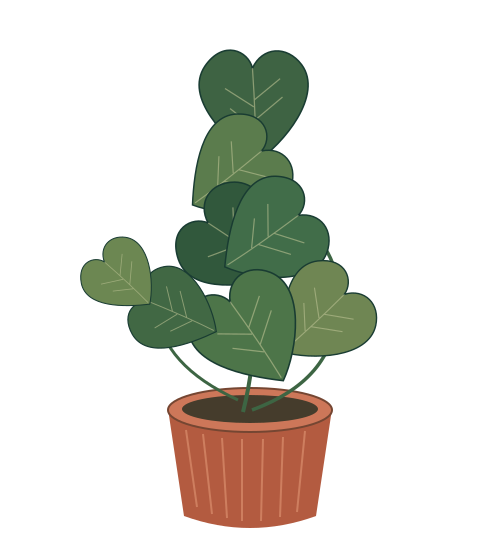
Growth habit
Some philodendrons climb or trail; others form upright, bushier plants.[2]
Light starting point
Bright indirect light, with the real position checked before changing it.[2]
Watering question
Has the upper mix dried, and is excess water removed?[2]
Sources checked 18 October 2026 (UTC). Source-based general guidance, written with AI assistance. Observation prompts are editorial suggestions. No plant has been assessed from these illustrations, and no horticulturist or veterinary review is claimed.
IDENTIFICATION & SCOPE
The name
and its limits.
This dossier gives general context for common indoor Philodendron and a closer view of the trailing or climbing heartleaf species, P. hederaceum. Older names for that species include P. scandens and P. oxycardium. It is not a specialist growing prescription for every species, hybrid or rare cultivar sold as a philodendron.[1]
A heart-shaped leaf is only a beginning
P. hederaceum can resemble pothos. NC State highlights its free stipules on new growth and leaf stalks that lack the characteristic pothos groove. Older stipules can dry and fall. Those details help explain why a clear stem-and-new-growth view is more useful than a distant heart-shaped outline.[1]
Keep a drying sheath, a damaged leaf and a visible insect as separate observations. Do not name every small brown structure a pest from a photograph you cannot resolve. If you are unsure what part you are looking at, say so and take a clearer view.
A nursery name is a useful starting reference. If it conflicts with the plant’s visible form, preserve that discrepancy rather than editing the observation to fit the label. The free Observation Desk is an appropriate place to organise that evidence.
Let the growth habit decide the support question
Climbing philodendrons can use a suitable support, while bushier forms generally do not need training. The RHS separates those habits rather than prescribing a pole for every plant in the genus.[2]
Follow one stem to understand whether it is trailing freely, attached to a support or part of a compact central plant. Record any point where its placement makes the pot hard to reach. A support should solve a real structural or space problem, not simply reproduce a picture of a different species.
If the concern is an untidy shape, describe the shape you want to manage. That is a valid care question. It should not be relabelled as poor health merely because the plant is growing beyond the original shelf.
Read new growth in its setting
Insufficient light can accompany longer, sparser growth with fewer or smaller leaves. Bright indirect light is the RHS starting point for common indoor philodendrons, while strong direct exposure can damage leaves.[2]
Compare the newest growth with earlier leaves on the same plant. Include any move, new blind or change in the way a climbing stem is supported. If you do not know whether a colour difference is typical of the cultivar, record it without deciding it is deficiency.
The point of a record is to make comparisons possible. Keep the date and the same whole-plant viewpoint, then add a detail only when it helps answer a specific question. Do not demand that a newly emerging leaf look identical to an older one before its development is clear.
Make the container legible
Before adjusting watering, describe the actual mix, drainage and outer-pot arrangement. Note when it was last checked as well as when it was last watered. In a shared household, ask whether someone else has already acted.
If new observations do not agree with the supplied identity or routine, clarify them first. A “Philodendron” label does not explain every yellow leaf or settle the condition of unseen roots. Persistent deterioration, a soft stem or a rapidly changing base warrants an in-person assessment.
YOUR ACTUAL CIRCUMSTANCES
Three things
to put on record.
- Is this a trailing heartleaf plant, a climbing form or an upright cultivar?
- Can the label, newest growth and leaf stalk be shown clearly enough for identification discussion?
- What changed in the setting, and which new leaves are being compared with which older ones?
For a useful file, combine the reported botanical name, the growth habit, a clear stem detail and the growing-pot observations. If the identification is unresolved, mark that boundary. A supported practical recommendation should fit the actual subject, not merely the nearest familiar member of a large genus.
Make an observation sheetHOUSEHOLD CAUTIONS
Keep the identity
with the advice.
Philodendrons should be kept out of reach of children and pets. Their sap may irritate skin; wear gloves when handling or pruning. If an animal may have eaten a potentially toxic plant, seek veterinary advice rather than using a common name to decide that it is harmless.[2][3]
Sources on the record
The numbered links attach practical claims to their sources. Observation prompts are editorial suggestions. Overseas calendar months and window directions need interpretation in the plant’s actual setting.
- Philodendron hederaceum — Plant Toolbox
NC State Extension - How to grow philodendrons
Royal Horticultural Society - Do You Know Which Flowers and Plants are Toxic to Pets? Our Experts Explain!
ASPCA Poison Control
Illustration: Original SVG illustration for The Plant Psychology Practice; no third-party image reproduced.