PUBLIC PLANT DOSSIER · 4 MINUTE READ
Spider plant
Chlorophytum comosum
Arching leaves, small offspring and the possibility that nothing is wrong.
The spider plant rewards a distinction between appearance and change. A dangling young plant, a curly cultivar or an old brown tip may prompt a question without establishing a crisis. Begin with the form of the whole plant and the history of the feature you have noticed.
Growth habit
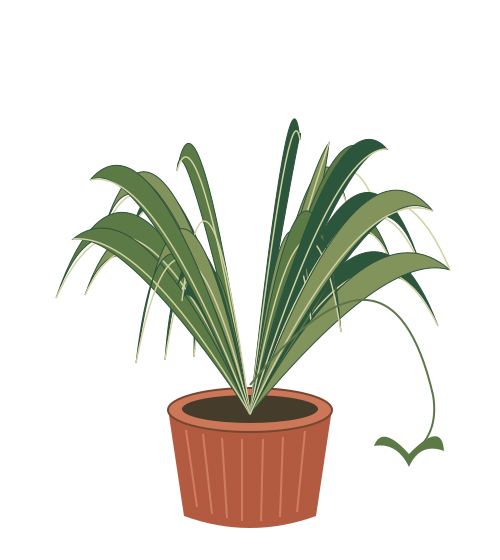
Arching, narrow leaves; long stems may carry flowers and plantlets.[2]
Light starting point
Bright indirect light; growth can slow in a dimmer position.[1]
Watering question
Is the mix lightly moist, and is there any trapped runoff?[1]
Sources checked 18 October 2026 (UTC). Source-based general guidance, written with AI assistance. Observation prompts are editorial suggestions. No plant has been assessed from these illustrations, and no horticulturist or veterinary review is claimed.
IDENTIFICATION & SCOPE
The name
and its limits.
This dossier concerns Chlorophytum comosum. The broader Chlorophytum group includes other species, and some plants sold under related names do not produce the familiar hanging plantlets. Keep the species or cultivar label where available. The absence of offspring is not enough to declare a plant unwell.[1]
The hanging additions belong to the plant
Chlorophytum comosum forms a short central crown of strap-like leaves. Its long stems can carry small white flowers and new plantlets. Green and variegated forms occur, so a white stripe is not required for every plant of the species.[2]
When a plantlet appears, record it as new growth before deciding whether to propagate it. The choice to keep or remove it can be about space and the owner’s preference. You do not need to turn every healthy plant into a production system, and no particular number of babies is a care score.
A brown tip needs context
Spider plant tip browning has several possible contributors, including watering extremes, strong sunlight, very dry air and fluoride in water. The tip alone does not identify which one applies.[1]
Describe whether the marks are confined to old tips or appearing on newer leaves. Add the timing of any move or change of water source. Do not buy several remedies at once on the strength of a familiar symptom. If you later adjust one plausible mismatch, judge progress from subsequent growth and the wider pattern.
Bent leaves need their own history. Note whether a shelf edge, a journey home or access to the pot could have damaged them. A dated whole-plant image can show that an old crease has stayed in the same place rather than becoming a new problem.
Make hanging care reachable
For a hanging plant, trace the practical route from the watering can to the growing pot and then to the drained water. Can the pot be checked without standing on unsafe furniture? Can a sitter see whether water remains inside an outer container? A beautiful position still needs a workable care arrangement.
If more than one person looks after the plant, agree who checks next. Write “checked; still moist” when no water was added. This is especially helpful when hanging foliage hides the pot and the next person cannot readily tell what happened.
When apparently healthy is the right conclusion
Record the ordinary things that are working: a secure hanging arrangement, the newest leaves, a familiar drying pattern and no spreading change. Those are observations, not a guarantee of perfect health. They are still enough to make an attentive record without inventing a disease.
Pip’s public file is an illustrative example of this approach. The plant is fictional and its report is not evidence of a real customer outcome. It shows how useful care can include restraint, clear checks and a record of what does not currently need intervention.
YOUR ACTUAL CIRCUMSTANCES
Three things
to put on record.
- Is the plant C. comosum, another Chlorophytum, or still unidentified?
- Are plantlets, flowers, tip marks and bends old features or newly recorded changes?
- Can the person who cares for it reach the growing pot and remove excess water safely?
Use the observation sheet to describe a stable plant as readily as a troubled one. A useful entry might say what the newest growth looks like, where the pot hangs, when it was last checked and what remains unknown. Keep the ordinary care instruction separate from Felix’s fictional description of a very busy household.
Make an observation sheetHOUSEHOLD CAUTIONS
Keep the identity
with the advice.
ASPCA lists Chlorophytum comosum as non-toxic to cats and dogs. That is species-specific information, not a promise that chewing plants is harmless: ASPCA notes that plant material can still cause stomach upset. Seek veterinary advice for suspected toxic ingestion or a pet that appears unwell.[3][4]
Sources on the record
The numbered links attach practical claims to their sources. Observation prompts are editorial suggestions. Overseas calendar months and window directions need interpretation in the plant’s actual setting.
- How to grow spider plants
Royal Horticultural Society - Chlorophytum comosum — Plant Toolbox
NC State Extension - Spider Plant
ASPCA Poison Control - Do You Know Which Flowers and Plants are Toxic to Pets? Our Experts Explain!
ASPCA Poison Control
Illustration: Original SVG illustration for The Plant Psychology Practice; no third-party image reproduced.